The best Boise neighborhood for retirement depends less on age and more on how you want everyday life to work.
Some retirees want a smaller low-maintenance home, quick access to healthcare, a short airport drive, walkable restaurants, trails and parks, a quiet established street, and room for visiting family.
Others are still working, traveling frequently, hiking, biking, skiing, or planning to stay in the same house for another 20 years.
That means there is no single best Boise neighborhood for retirees.
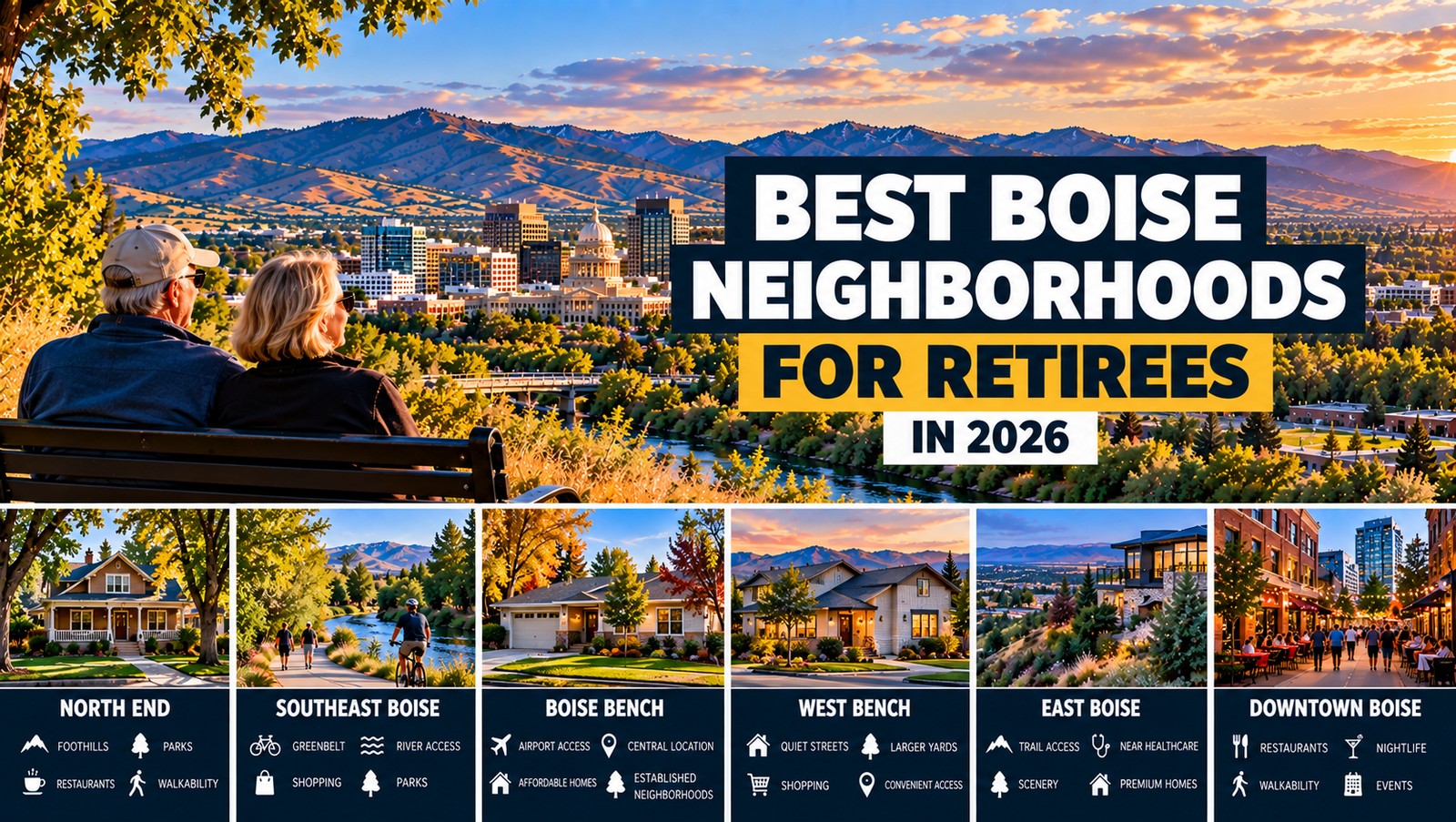
For 2026, some of the strongest areas to consider include Southeast Boise, Boise Bench, West Bench, North End, East Boise, and Downtown.
Each offers a different combination of cost, convenience, healthcare access, outdoor recreation, and housing style.
Start With the Life You Want, Not the Neighborhood Name
Before choosing a neighborhood, ask how much house you really want to maintain, how close you want to be to healthcare, how often you fly, whether you want to walk to restaurants, whether Greenbelt or foothills access matters, whether you need a single-level home, how often family will visit, and how much driving you want to do.
Those questions matter more than whether a neighborhood is considered prestigious.
Healthcare Access Matters More Over Time
Boise has two major hospital systems with significant Boise facilities.
St. Luke's Boise Medical Center is near Downtown and offers emergency, inpatient, outpatient, surgical, cancer, and diagnostic services.
Saint Alphonsus Regional Medical Center is along Curtis Road and provides emergency, trauma, cardiac, cancer, neurological, surgical, and other advanced services.
That makes central Boise neighborhoods particularly useful for retirees who expect healthcare access to become increasingly important.
Southeast Boise
Southeast Boise is one of the strongest all-around choices for active retirees.
Current Redfin data puts the median sale price around $560,000 over the three months ending August 2026.
Zillow's typical home value is about $541,000.
That places Southeast Boise near the middle of Boise's current housing market rather than at the luxury end.
Why Southeast Boise Works for Retirees
The area gives you access to the Boise River Greenbelt, parks, Bown Crossing, Parkcenter, Boise State, healthcare offices, Downtown, and airport routes.
For an active retiree who wants to walk or bike regularly without living in a dense urban environment, Southeast Boise has a lot going for it.
Read our Boise Greenbelt Guide.
Boise Bench
Boise Bench deserves serious consideration for retirees because of its central location.
The Bench puts you between many of the places retirees use most often.
You can reach Downtown, Boise Airport, Saint Alphonsus, I-84, West Boise, and Southeast Boise without crossing the entire metro.
Healthcare Is a Strong Bench Advantage
Saint Alphonsus Regional Medical Center sits along Curtis Road, making the Bench and nearby west-central neighborhoods especially convenient for that hospital system.
For someone who expects regular specialist visits, physical therapy, procedures, or hospital appointments, proximity can become a major quality-of-life feature.
Airport Access Is Excellent From the Bench
Boise Airport currently has eight airlines serving 29 nonstop destinations.
For retirees who expect to visit children, see grandchildren, travel internationally through connecting hubs, or spend winters elsewhere, airport convenience can matter enormously.
The Bench provides some of Boise's easiest access to the terminal.
Read our Boise Airport Guide.
The Bench Can Also Be More Affordable
Some Bench neighborhoods are significantly less expensive than North End or East End.
Current market estimates place Central Bench around the upper-$300,000s to low-$400,000s.
That can make it attractive for retirees trying to preserve cash or reduce housing expenses.
Older Bench Homes Need Careful Inspection
The tradeoff is housing age.
Look closely at roof, HVAC, electrical panel, plumbing, sewer line, insulation, and windows.
A lower purchase price can be offset by major repairs.
For retirement housing, predictable maintenance matters.
West Bench
West Bench may be one of the strongest options for retirees who want a quieter suburban feel without moving far outside Boise.
The appeal is practical.
You may find established subdivisions, yards, quieter streets, shopping nearby, west Boise access, and reasonable central-city access.
West Bench Can Work Well for Downsizers
Not everyone wants a condo.
Some retirees still want a garage, small yard, guest room, office, or workshop.
West Bench can offer a better balance of space and price than some central neighborhoods.
North End
North End is one of Boise's strongest lifestyle choices for retirees with larger housing budgets.
Redfin reports a median sale price around $778,000, while Zillow's typical value is around $742,000.
That makes it a premium neighborhood.
Why North End Appeals to Active Retirees
You get Hyde Park, Camel's Back Park, foothills access, Downtown proximity, mature trees, neighborhood restaurants, and walkable streets.
For retirees who want to stay active and do not want suburban isolation, North End can be compelling.
Depending on where you live, you may be able to walk or bike to restaurants, coffee, parks, Downtown, and trails.
Historic Homes Are Not Always Retirement-Friendly
A charming bungalow may also have stairs, narrow doorways, older bathrooms, basement laundry, and limited garage space.
If you are buying for the next 20 years, think about aging in place.
Character is great. Accessibility matters too.
East End
East End is another premium choice.
The broader North-East Ends market recently showed median sale prices around the upper-$800,000 range.
The area offers foothills, Downtown proximity, Warm Springs, trails, and established neighborhoods.
It can be especially attractive to higher-budget retirees who want outdoor access without giving up central Boise.
St. Luke's Access Is Excellent From East Boise
St. Luke's Boise Medical Center is located just east of Downtown.
That gives East End and nearby central neighborhoods relatively convenient access to a major medical center.
For retirees with ongoing care needs, that may matter as much as restaurants or trails.
Downtown Boise
Downtown is worth considering for retirees who want a more urban, low-maintenance lifestyle.
You can get close to restaurants, events, theaters, healthcare, Greenbelt, and services without maintaining a large yard.
Condo Living Can Simplify Retirement
A condo may eliminate responsibility for exterior maintenance, yard work, roof, and snow removal in some communities.
That can be appealing.
But HOA quality becomes extremely important.
Review dues, reserves, insurance, special assessments, elevator maintenance, parking, and rental rules before buying.
Downtown Walkability Is Hard to Beat
Downtown Boise is one of the city's strongest areas for walking to restaurants, events, and everyday services.
That can make it a strong fit for retirees who want to reduce daily driving.
Best Neighborhood for Healthcare Access
For Saint Alphonsus access, Boise Bench and west-central Boise deserve attention.
For St. Luke's Boise access, Downtown, East End, and nearby central neighborhoods make sense.
This is not about ranking healthcare systems. It is about reducing drive time to the providers you actually use.
Best Neighborhood for Frequent Travelers
Boise Bench has a strong case.
If retirement includes frequent travel, a shorter airport drive can be worth more than an extra bedroom.
Best Neighborhood for Active Retirees
Southeast Boise and North End both stand out.
Southeast Boise works especially well for Greenbelt, cycling, river access, and parks.
North End works especially well for foothills, hiking, neighborhood walking, and Downtown access.
Best Neighborhood for a Lower Housing Budget
Central Bench and parts of the broader Bench deserve a close look.
Current typical values are well below premium neighborhoods such as North End and East End.
That difference can preserve a substantial amount of retirement capital.
Best Neighborhood for Higher-Budget Retirees
North End and East End offer some of the strongest lifestyle combinations for retirees who can comfortably afford them.
But do not stretch your budget just to live there.
Retirement finances need flexibility.
Housing Cost Matters More in Retirement
A household earning $150,000 during peak career years may tolerate a large mortgage.
That same payment can feel very different on retirement income.
Before buying, calculate mortgage, taxes, insurance, HOA, maintenance, healthcare, and travel together.
A Paid-Off House Can Change the Equation
Some retirees arrive in Boise after selling a home elsewhere.
That may allow them to buy with a large down payment, substantial equity, or cash.
That makes expensive neighborhoods much more manageable.
But do not put every available dollar into the house.
Keep reserves.
Maintenance Should Influence Neighborhood Choice
A large foothills property may look beautiful.
It may also involve landscaping, irrigation, stairs, snow, roof maintenance, and hillside drainage.
Retirement is a good time to ask whether you want more property or less responsibility.
Single-Level Homes Become More Valuable
Even if stairs are no problem today, consider the next 10 or 20 years.
Useful features can include a primary bedroom on the main floor, walk-in shower, minimal steps, wider hallways, attached garage, and low-maintenance yard.
Buying for future usability can reduce the need to move again later.
Foothills Homes Need Extra Thought
Foothills locations offer views, privacy, and trails but may also have steep driveways, wildfire exposure, winter access concerns, and more landscaping complexity.
That does not make them a poor choice.
It means they require more planning.
Wildfire Smoke and Winter Air Quality
Active retirees may spend more time outside than working households.
That makes summer smoke an important consideration.
Boise can also experience winter inversions that trap pollution near the valley floor.
People with respiratory concerns should consider air quality alongside temperature when evaluating Boise retirement.
Parks Are Everywhere
Boise maintains more than 101 parks across the city.
Retirees may care less about playgrounds, but parks still provide walking, birding, picnics, dog walking, community events, and open space.
Living near a park can improve daily quality of life.
Grandchildren Change the Housing Decision
A retiree who expects frequent family visits may want a guest bedroom, nearby park, airport access, second bathroom, and flexible living space.
Do not downsize so aggressively that visiting family becomes difficult if family visits are important to you.
Retirement Travel Changes the Equation
If you expect to spend part of the year elsewhere, consider how easy the property is to leave unattended.
A condo or low-maintenance townhome may make more sense than a large irrigated yard.
Best Neighborhood for Retirees Who Still Work
If you are semi-retired or still working, commute still matters.
Do not buy a retirement house that creates an hour of unnecessary daily driving for the next five years.
Read our Boise Commute Guide.
Best Neighborhood for Retirees Who Love Downtown
North End, Downtown, and East End deserve attention.
They give you easier access to restaurants, performances, events, markets, and cultural activities without a long drive from the edge of the metro.
Best Neighborhood for Retirees Who Want Quiet
West Bench and selected Boise Bench areas may provide a strong balance of quieter residential streets, central access, and lower housing costs without moving far from hospitals or the airport.
Do Not Automatically Move to the Suburbs
A newer house farther west may provide more square footage, newer finishes, and less immediate maintenance but may also mean more driving to hospitals, the airport, Downtown, specialists, and friends.
That may or may not be worth it.
Do Not Automatically Stay Central Either
A central neighborhood can be expensive.
If paying a premium means reducing travel, savings, healthcare flexibility, or emergency reserves, the location may not be worth it.
A Practical Retirement Shortlist
If I were helping a retiree narrow Boise, I would start with Southeast Boise for Greenbelt, parks, active lifestyle, and overall balance.
Boise Bench for healthcare access, airport convenience, and central geography.
West Bench for quieter established neighborhoods and potentially lower housing costs.
North End for higher-budget retirees who prioritize walkability, foothills, and neighborhood character.
East End for higher-budget retirees who want foothills access and proximity to St. Luke's and Downtown.
Downtown for retirees seeking condo living, walkability, and lower exterior maintenance.
Then I would narrow the list based on healthcare providers, budget, and how much property you actually want to maintain.
The Bottom Line
There is no single best Boise neighborhood for retirees.
The strongest choice depends on what you want retirement to look like.
For active retirees who want Greenbelt access, parks, and a strong central location, Southeast Boise is one of the best all-around options, with a current median sale price around $560,000.
For retirees prioritizing healthcare and airport access, Boise Bench deserves serious attention.
For retirees with larger budgets who value walking, foothills, and neighborhood character, North End remains compelling, but its current median sale price near $778,000 makes it a premium choice.
For households trying to keep housing costs lower, Central Bench and similar Bench neighborhoods can be far more attainable.
The right retirement neighborhood should make life simpler.
It should put you near the healthcare you use.
It should make travel easier.
It should support the activities you enjoy.
And it should leave enough money and flexibility to actually enjoy retirement.
Choose the neighborhood that supports the life you want after you stop organizing everything around work.
This post may contain affiliate links. We may earn a commission when you purchase through links on this site at no additional cost to you.